
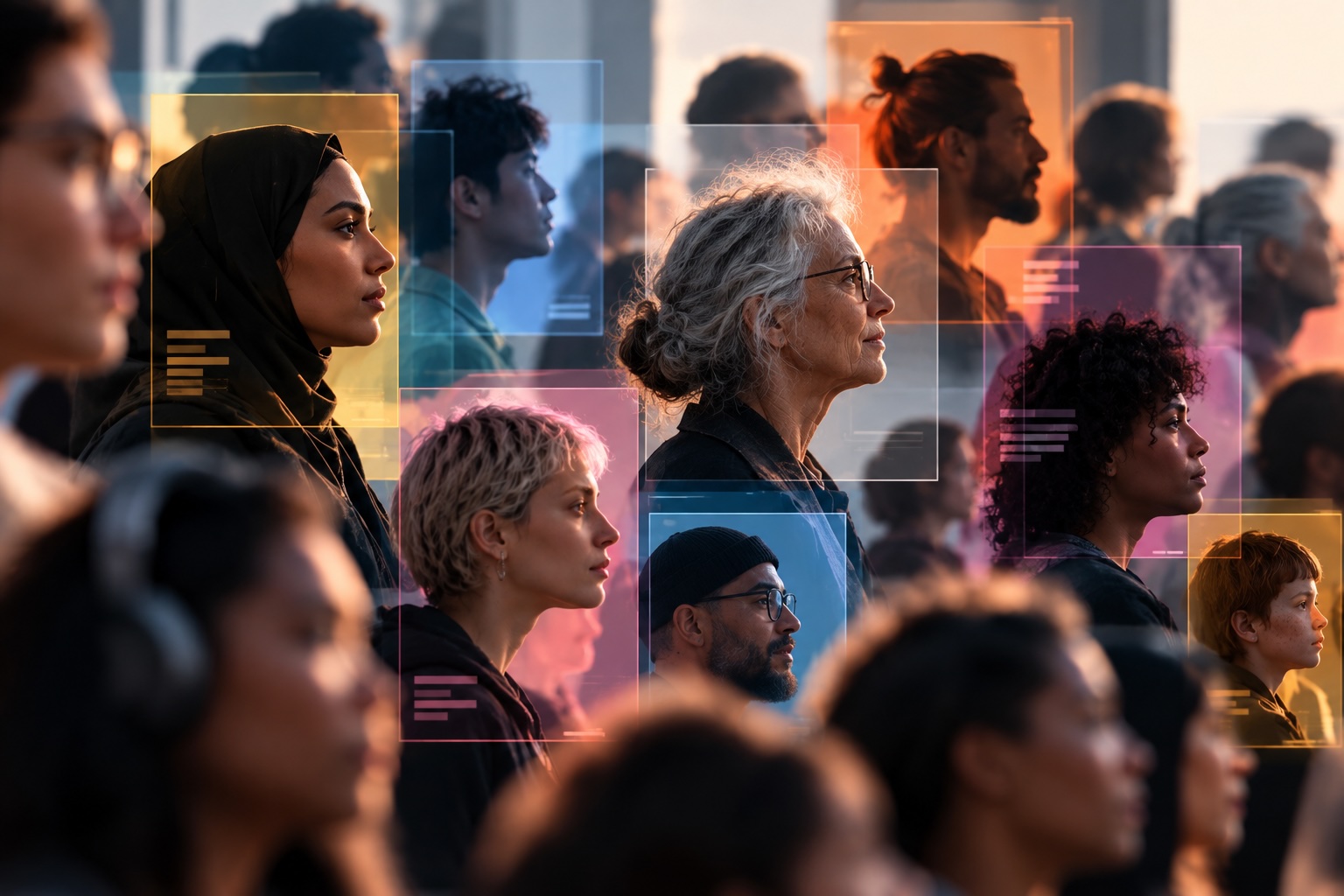

We design products, services and technologies for people. But which people are we actually designing for?
Imagine that you are designing a door for the average person. You begin by calculating the average height, reach and physical strength of the people who are expected to use it. Based on these measurements, you determine the position of the handle, the force required to open the door and the dimensions of the entrance. The result appears reasonable. It is based on data, follows a consistent process and has been designed around a clearly defined user.
Yet the door may be difficult for a child to open, impossible for some wheelchair users to reach and uncomfortable for someone with limited hand strength. The calculations may be perfectly correct, but the underlying assumption is flawed. An average can describe a population without adequately representing the individuals within it.
This problem extends far beyond the design of physical environments. The same assumptions influence how we develop digital services, organise workplaces, design education and train artificial intelligence. We routinely make decisions based on an imagined average person, even though the people who eventually encounter our products and services differ in countless ways.
The consequences are not limited to accessibility. When we design around a narrow understanding of human experience, we also risk overlooking opportunities for innovation. Different abilities, backgrounds, generations and ways of interacting with the world can reveal possibilities that conventional design processes fail to recognise.
Perhaps the problem is not simply that we need to design better for people who fall outside the average. Perhaps we need to reconsider why the average became our starting point in the first place.
The convenience of the average
Averages are indispensable tools. They allow us to understand populations, identify patterns and make decisions in situations where accounting for every individual circumstance would be impractical. Statistical generalisation is fundamental to research, planning and technological development, and there is nothing inherently wrong with using it.
The difficulty arises when a statistical description is transformed into a design ideal. An average user may be imagined as someone with a particular level of physical ability, digital confidence, language proficiency and familiarity with technology. These characteristics are rarely stated explicitly. Instead, they become embedded in decisions about interfaces, workflows, communication and the organisation of services.
A digital service might assume that users can navigate complex menus and understand administrative terminology. An educational platform might be designed around a particular way of reading, concentrating and processing information. A workplace system might assume that employees can interact with technology under similar physical and cognitive conditions. None of these choices necessarily reflects a conscious intention to exclude anyone. More often, they reflect assumptions that appear natural to the people developing the solution.
That is what makes them difficult to recognise. When designers, developers and decision-makers share similar experiences, their understanding of what is normal can become the invisible foundation of a product. What works for them is assumed to work for others, and differences are discovered only when users encounter problems.
The average user becomes particularly problematic when it is treated as a real person rather than a statistical abstraction. A product may be optimised for a combination of average characteristics that relatively few individuals possess simultaneously. Even when a design works adequately for most people, it may fail to account for the circumstances in which people actually use it.
The challenge is therefore not to abandon averages, but to understand their limitations. They can help us identify patterns, but they cannot replace an understanding of human variation.
Human difference is not an exception
People do not experience technology in the same way. Some rely primarily on visual interfaces, while others use screen readers or other assistive technologies. Some communicate through speech, while others depend on text, symbols or alternative communication methods. People differ in their physical capabilities, cognitive processes, language skills, confidence and access to resources. They also use technology in different environments and under changing circumstances.
These differences are not necessarily permanent. A person with excellent vision may struggle to read a screen in bright sunlight. Someone who normally uses a keyboard may need voice control after an injury. A person who navigates digital services confidently may find the same services difficult to understand when dealing with illness, stress or an unfamiliar administrative situation.
Our capabilities also change throughout life. We learn new skills, develop habits, grow older and adapt to circumstances that alter what we can do independently. The distinction between people who fit a design and people who require special accommodation is therefore less stable than it often appears.
Nevertheless, many design processes continue to treat human difference as a collection of exceptions. A standard solution is developed for the imagined majority, after which additional features or adaptations are introduced for those who cannot use it. Accessibility becomes something that is added to an existing product rather than a consideration that influences its original conception.
This approach may improve access, and adaptations will sometimes be necessary. But it also limits what we can learn from people whose experiences differ from those of the designers. If difference is considered only after the central decisions have been made, its potential to influence the fundamental design may already have been lost.
An alternative is to recognise human variation as a basic condition of design. Rather than beginning with an assumed normal user and accommodating exceptions, we can explore the range of experiences, capabilities and circumstances that a product or service must address.
That change in perspective can reveal opportunities that would otherwise remain invisible.
When accessibility becomes a source of innovation
Accessibility is often discussed as a matter of removing barriers. This is essential, particularly because equal access should not depend on whether accommodating different needs produces a commercial benefit. But accessibility can also challenge established assumptions about how products and services should function.
Speech recognition, for example, provides important opportunities for people who cannot easily use a keyboard or touchscreen. The same technology can be useful when someone is driving, cooking or otherwise unable to interact with a device using their hands. Captions are essential for many people who are deaf or hard of hearing, but they can also make video content more useful in noisy environments or situations where audio is unavailable. Adjustable text sizes can improve access for people with visual impairments while also helping others read information under difficult conditions.
These examples do not demonstrate that every accessibility feature will benefit everyone. Nor should accessibility be justified primarily through its usefulness to people without disabilities. Their significance lies elsewhere: a need that appears specific to one group can reveal limitations in a conventional design and suggest alternatives that have wider applications.
This creates an important distinction between designing for difference and designing with difference. Designing for difference can mean identifying barriers and developing ways to remove them. Designing with difference goes further by treating people’s varied experiences as sources of knowledge that can influence which problems are addressed and which solutions are imagined.
Consider a company developing a new communication platform. If the development team assumes that communication primarily means exchanging written messages, accessibility may initially be understood as making the text interface compatible with assistive technologies. That is important, but involving people with different communication needs at an earlier stage might lead the team to question whether written messages should be the central interaction method at all. The resulting exploration could include speech, symbols, alternative interfaces or combinations of different communication methods.
The value of this approach is not that it guarantees a better product. It is that it expands the range of possibilities considered before the design becomes fixed.
Innovation is frequently described as the ability to imagine something new. Human difference can contribute to that process by exposing assumptions that would otherwise remain unquestioned.
Who gets to influence the design?
The people involved in developing technology inevitably influence its direction. Their knowledge, professional priorities and personal experiences affect which problems are considered important, which solutions appear promising and which outcomes are used to evaluate success.
This does not mean that developers deliberately ignore people whose circumstances differ from their own. It means that some challenges are difficult to recognise without encountering them directly or listening to those who do.
Imagine a public institution developing an AI-powered service to help citizens navigate administrative procedures. The project team may include experienced developers, designers, legal specialists and public administrators. They may evaluate the system carefully in terms of accuracy, security, efficiency and user satisfaction. Yet if the people involved share similar assumptions about how citizens communicate and understand information, they may overlook difficulties experienced by people with cognitive disabilities, limited language proficiency or complex personal circumstances.
The system could function exactly as intended while remaining difficult to use for some of the people who need it most. It might provide accurate information but require users to formulate questions in ways they find difficult. It might offer a clear sequence of steps while failing to accommodate situations that do not fit the expected pattern. These problems are not necessarily technical failures. They may be consequences of how the service was originally conceived.
Testing the finished system with a broader group of users can reveal such limitations, but by then many fundamental decisions may already have been made. The architecture may be established, the budget allocated and the measures of success agreed upon. Changes can become expensive or difficult, particularly when they challenge assumptions on which the entire project is based.
Meaningful participation therefore needs to begin before the solution has been defined. People with different experiences should have opportunities to influence how a problem is understood, which alternatives are explored and what counts as a successful outcome.
This is not simply a question of representation. Inviting people into a process does not necessarily mean they have influence over it. Their perspectives become valuable when they can change the questions being asked and the decisions being made.
The ambition should not merely be to ensure that everyone can use what has already been designed. It should also be to explore what different people might have helped us imagine if they had been involved from the beginning.
Artificial intelligence makes the question more urgent
Artificial intelligence introduces new possibilities and new complications to this discussion. AI systems identify patterns in data and are evaluated according to selected measures of performance. Both the data and the evaluation criteria reflect decisions about which characteristics, behaviours and outcomes matter.
An AI system may perform well in general evaluations while being less reliable for people whose circumstances are poorly represented in its training or testing. A speech interface may work effectively for many users while struggling with certain speech patterns. An automated decision-support system may generate apparently consistent recommendations while overlooking circumstances that are important for particular individuals.
These limitations are not always solved simply by adding more data. They also require us to consider how systems are designed, which outcomes are prioritised and how people can question or influence the decisions that affect them.
The issue becomes particularly significant when AI is integrated into public services, workplaces, healthcare or education. In these settings, assumptions about human behaviour can become embedded in systems that influence access to information, opportunities and resources. What begins as a design choice may eventually become part of the infrastructure through which people interact with institutions.
At the same time, AI offers possibilities for moving beyond rigid assumptions about users. Adaptive interfaces, personalised support and new assistive technologies could make products and services more responsive to individual circumstances. Systems may become better at offering different ways of communicating, accessing information and completing tasks.
But personalisation is not automatically the same as inclusion. A system can adapt to a person’s behaviour while still restricting the choices available to them. It can become highly effective at predicting what someone is likely to do without expanding their ability to decide what they want to do.
The more ambitious objective is therefore not simply to create technologies that adapt to human differences. It is to develop technologies that expand people’s opportunities to understand, choose and act.
That requires us to consider human difference not only as a technical challenge, but also as a question about agency and influence.
Beyond disability: the value of different experiences
Disability provides particularly clear examples of what happens when design assumptions fail, but the underlying issue is much broader. Age, education, language, culture, economic circumstances and professional experience all influence how people encounter technology and understand the possibilities it creates.
Different generations, for example, may approach the same technology with different expectations. Someone who has grown up with digital services may question why a process requires physical attendance or manual paperwork. Someone with decades of professional experience may recognise consequences that are invisible to people who have never worked without digital systems. Neither perspective is inherently more valuable, but each can reveal aspects of a problem that the other may overlook.
Similar differences exist within organisations. A senior manager may understand the strategic objectives behind a new technology, while a frontline employee understands how it will affect daily work. A developer may recognise technical opportunities, while a customer sees how the proposed solution fits into a much broader set of practical needs.
These perspectives can complement one another, but they can also conflict. What appears efficient to one group may create additional work for another. A feature that improves access for some users may introduce difficulties for others. Different people may have legitimate but competing priorities.
Recognising the value of difference does not mean assuming that every perspective is equally relevant to every decision or that bringing diverse people together will automatically produce innovation. Differences can create tension, and participation requires careful consideration of whose knowledge is relevant, how disagreements are handled and who ultimately makes decisions.
The opportunity lies in treating these differences as useful information rather than obstacles to consensus. They can reveal trade-offs, expose assumptions and broaden the range of solutions under consideration.
A genuinely constructive approach to human difference therefore requires more than good intentions. It requires methods that allow different experiences to influence how problems are defined and how possible solutions are developed.
Designing beyond the average
If the average human is an inadequate starting point, what should replace it?
The answer is not to create a unique solution for every individual. Such an approach would often be impractical and could introduce new problems of complexity, cost and maintenance. Nor is it realistic to imagine that every product or service can accommodate every possible need without trade-offs.
A more useful approach begins by recognising variation rather than treating it as an exception. Designers and decision-makers can investigate the different circumstances in which a product or service will be used, identify where needs overlap and explore where flexibility or alternative forms of interaction could create value.
This may involve designing systems that offer more than one way to complete an activity. It may mean involving people with different experiences earlier in development or reconsidering which outcomes should define success. In some cases, it may require acknowledging that a single solution cannot adequately serve everyone and that meaningful alternatives are necessary.
Crucially, the process should not focus exclusively on identifying barriers. It should also ask what different experiences can reveal about opportunities that have not yet been considered.
A person who cannot use a conventional interface may inspire an entirely different form of interaction. Someone unfamiliar with established professional routines may question why a process is organised in a particular way. A person whose needs are poorly served by existing products may reveal an opportunity for a new service or business model.
These possibilities are not guaranteed. They must be explored, evaluated and tested. But they are less likely to emerge if the development process begins and ends with the assumptions of a relatively homogeneous group.
The objective is not to eliminate human difference through increasingly sophisticated technology. It is to understand how difference can contribute to the technologies and services we choose to create.
The future will not be experienced by an average person
For decades, much of the conversation about inclusive design has focused on ensuring that more people can access products, services and environments. That work remains essential, and accessibility should never become dependent on its potential to generate innovation or commercial value.
But our ambitions can extend further. Human difference can do more than reveal where existing designs fail. It can help us reconsider what we build, which problems we prioritise and what kinds of value technology might create.
This requires a shift in perspective. Instead of imagining innovation as a process in which experts develop solutions that are subsequently adapted to different users, we can recognise that different human experiences may contribute to the innovation process itself.
The people who encounter barriers are not only potential beneficiaries of better design. They may also possess knowledge that helps us discover better ways of designing. The same applies to people from different generations, professional backgrounds and social circumstances whose experiences challenge what others take for granted.
None of this means that difference automatically produces better outcomes. Its value depends on whether we are willing to listen, challenge our assumptions and allow unfamiliar perspectives to influence our decisions.
The average human remains useful as a statistical concept. But it is a poor substitute for understanding the people who will live with the consequences of what we create.
The future will not be experienced by an average person. It will be experienced by all of us, differently. And that difference may be one of our most important resources for shaping what becomes possible.
A question worth discussing
Think of a product, service or technology you use regularly. Who does it appear to have been designed for, and what might change if people with very different experiences had been involved from the beginning?